When should a DTC brand hire a Google and Meta Ads agency instead of a freelancer?
The stages of a DTC brand, the real and false signals that it's time to move to a Google and Meta Ads agency, and how to switch fairly, including towards your freelancer.
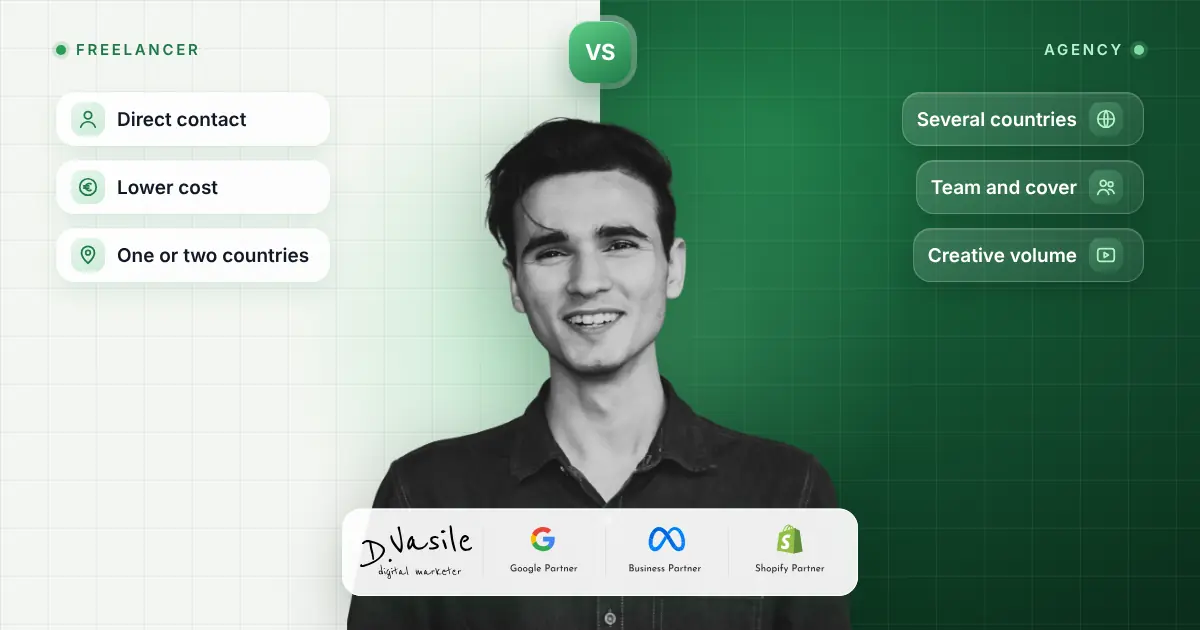
I've already written about freelancer or marketing agency in general. Here I answer a more specific question I hear from brands that sell directly online: at what point is it worth moving from a freelancer to an agency for Google Ads and Meta Ads? Not “which is better”, but “when”. I work as a freelancer and consultant myself, so I've tried to be honest about the moments when an agency is the right choice.
Looking for a PPC agency? See how I work with Google Ads and Meta Ads and run your numbers before you start.
Who fits each stage of a DTC brand
Launch and validation
You have a product and a site, and you want to find out if it sells. You have a few campaigns on Google and Meta, the budget is small, and the main problem is correct tracking and the first sales. Here a good freelancer is almost always the right choice. An agency would cost more than the work in the account is worth.
Growth in one market
The product sells, the budget grows month by month, and next to Search, Shopping and Performance Max you also run Advantage+ campaigns on Meta. A senior freelancer with e-commerce experience handles this stage very well. The quality of the person matters more than the size of the team.
Expansion and scaling
You enter other countries, the catalogue grows, and you need video for YouTube and Reels and new images every month. The work no longer fits into one person's schedule. This is the stage where an agency, or a consultant who coordinates several specialists, starts to pay off.
Clear signs that it's time
- You're launching a second or third country. Each market has its own campaigns, feed and budget. I explained why in the article about separate campaigns by country.
- Creative has become the bottleneck. On Meta, ads wear out within a few weeks, and Performance Max and Demand Gen also need new images and video. If nobody produces them, results drop on both platforms.
- The feed takes time every week. The same catalogue feeds Merchant Center and the Meta catalogue. Disapproved products, wrong variants, prices that don't match. With a large catalogue, this is a separate job.
- Budget grows, sales don't. More money in the same campaigns no longer brings results, and nobody is testing new channels.
- Everything depends on one person. If the freelancer goes on holiday or quits, nobody knows how the accounts are built.
- Simple changes take time. When a one-hour change waits a week, the problem isn't quality, it's capacity.
False signals, when it isn't time
- One weak month. Seasonality and competition move the numbers. Look at the last three months, not the last three weeks.
- Tracking is broken. If sales aren't measured correctly, no team can optimise. Fix measurement first, from the Pixel and Conversions API on Meta to double conversions in Google Ads.
- The problem is the site or the product. Ads bring people in, but they don't fix a slow page, a wrong price or a weak offer. An ad agency won't solve that.
- A good sales pitch. A bigger team doesn't automatically mean better results. Ask who actually works in your account.
How to switch without losing what you've built
- Check ownership. The Google Ads account, GA4, Google Tag Manager and Merchant Center, plus the Meta Business Manager, ad account, Pixel and catalogue, should be in your company's name, with you as admin. Partners get access, not ownership.
- Ask for a written handover. Campaign structure on both platforms, negative keyword lists, audiences, conversion actions, the ads that worked and tests already tried. A page or two is enough.
- Set your baseline from the store. Sales, margin and MER from recent months, not platform ROAS. A one-page Looker Studio dashboard makes the comparison easy.
- Allow an overlap period. Two to four weeks in which the agency learns the account before changing anything important.
- Don't rebuild everything in the first month. Automated campaigns need data. A full restructure right after takeover resets learning and lowers sales.
What to ask the agency for in the first 90 days
- A written audit of the Google and Meta accounts, with the first three things to fix.
- A monthly test plan, not just unnamed optimisations.
- Reporting tied to orders and margin in your store.
- The names of the people who work in the accounts every day, and a monthly meeting with them.
What's fair to the freelancer who got you here
Your freelancer built the accounts, fixed the tracking and grew sales to the point where you need more. Moving to an agency isn't their failure. Often it's proof that they did good work. A few things I'd do:
- Talk to them before you sign with someone else. Tell them openly what you feel is missing. Sometimes they can bring in collaborators, move to a strategy role or work alongside the agency.
- Respect the notice period and pay everything. Including the last month and the time spent on the handover. A handover is work and deserves to be paid.
- Let them hand over the account. Remove access after the handover, not before, and tell them when you do it.
- Recognise what they built. Don't let the new agency present their results as its own, or criticise their work just to look better.
- Offer a recommendation. A review, a message on LinkedIn or permission to use the project as a case study. For a freelancer, that's worth a lot.
Parting fairly also keeps someone who knows your accounts. If the switch doesn't go the way you hoped, it's good to have someone to come back to.
Check yourself
Frequently asked questions
Conclusion
For a DTC brand, the moment to move to an agency for Google Ads and Meta Ads doesn't come from a certain budget, but from the workload: more countries, more creative, a large feed and the risk of depending on one person. Until then, a senior freelancer is usually more efficient. When you switch, keep the accounts in your name, measure on real orders and don't rebuild everything in the first month. If you'd like an opinion on your accounts before you decide, see the pages about Google Ads and Meta Ads or write to me via contact.
Free check: find out in 5 minutes how much budget you're losing in Google Ads and Meta Ads. Answer 15 questions and get a score and a list of things to fix. Take the free check.