The true cost of an order: what's left after shipping, payment, returns and ads
I break a typical order into pieces, from VAT to returns and ads, so you see the real contribution and the most you can pay for ads.
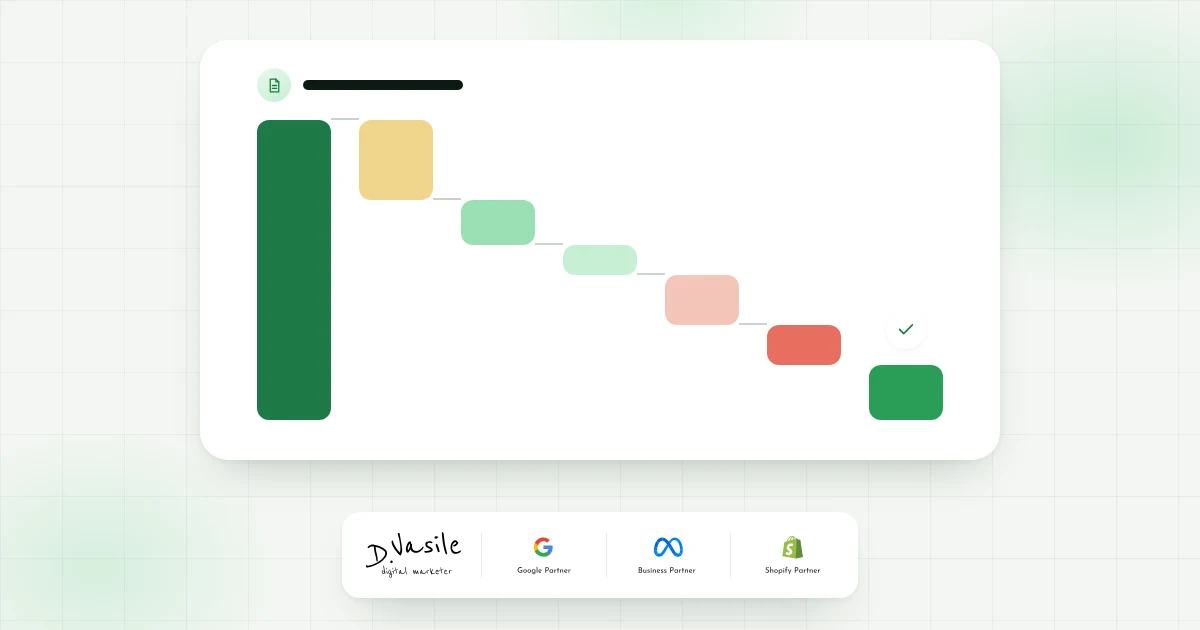
When a client tells me a product "has a 60% margin", my first question is: from which price, and after which costs? Usually the figure is just the gap between the price on the site and the purchase price. But between the €49 the customer pays and the money you actually keep sit VAT, packaging, picking time, shipping, payment fees, returns and advertising. In this article I take a typical order and break it into pieces, so you can see the real contribution per order and the most you can pay for ads. At the end there's a calculator where you plug in your own numbers.
1. What goes into the true cost of an order
The true cost of an order is everything you pay to get the product to the customer and keep it there. I split it into eight parts:
- Product cost, excluding VAT, including inbound freight if you pay it separately.
- Packaging: box, filler, tape, label, maybe an insert.
- Picking, packing and support: the minutes spent picking and packing plus time answering questions.
- Shipping you pay, meaning the part the customer doesn't.
- Payment fee charged by your card processor or wallet provider.
- Returns, as an average across all orders, not just the returned ones.
- Ad cost per order, your ad spend divided by the number of orders.
- Contribution, what's left after all that, which pays rent, fixed salaries and profit.
2. Start from the price excluding VAT
VAT isn't your revenue; you collect it for the state. The rate depends on your country and product, so use your own; in my example I use 21%. A product sold for €49 then means €40.50 excluding VAT. I calculate every percentage below from that figure, not from the price on the site.
If you're VAT registered, take product cost excluding VAT too, because you reclaim the VAT on purchases. If you're not, the picture changes, and that's worth a conversation with your accountant.
3. Product, packaging and time
Product cost is usually the biggest piece, but it's also the one you know. Packaging and time are the ones almost everyone underestimates. An example: if packing an order takes 6 minutes and an hour of work costs you €15 with taxes included, that's €1.50 per order just for picking and packing. Add a few minutes for emails and calls and you easily reach €2 or €2.50.
Even if you pack the orders yourself in the evening, your time has a cost. Otherwise, when you hire someone or move to a fulfilment warehouse, the cost appears overnight and breaks every calculation.
4. Shipping and payment
Shipping is the cost that grows most often without you noticing, especially when you offer free delivery over a threshold. For each order, only the part you pay counts. If your free shipping threshold is too low, you pay shipping on small orders whose contribution can't carry it; I wrote about this in the free shipping threshold.
For payments, card processors usually charge a percentage of the amount, sometimes plus a fixed fee per transaction. Take the figures from your contract, not from the pricing page, and check whether the fee is returned to you when you refund a customer.
5. Returns: the cost you forget
A return doesn't just cost the shipping back. You lose the revenue from the order, you pay for the return and for checking the product, and the shipping, packaging and time for the original delivery are already spent. That's why I put returns into the calculation as an average across all orders: the return rate multiplied by what you lose on one return.
In my example, with an 8% return rate and €6 cost per return, each order carries €2.36 of return costs. That assumes the returned product can be sold again; if it can't, the cost is higher. I covered how to bring returns down in the cost of ecommerce returns.
6. Ad cost per order and break-even
What's left before ads is the most you can pay for an order without losing money. Pay more and every new order lowers your profit. For customers who come back, you can accept a higher cost on the first order for a while, but only if your data shows they actually return. I explained the calculation in detail in maximum CPA per order and the difference from ROAS in contribution margin vs ROAS.
7. The full example
A €49 product including VAT, with example figures:
Item Price excl. VAT Amount €40.50 Share of price excl. VAT 100% Item Product cost Amount €17.00 Share of price excl. VAT 42.0% Item Packaging Amount €1.00 Share of price excl. VAT 2.5% Item Picking and support Amount €1.50 Share of price excl. VAT 3.7% Item Shipping you pay Amount €5.00 Share of price excl. VAT 12.3% Item Payment fee 2.5% Amount €1.23 Share of price excl. VAT 3.0% Item Returns 8% Amount €2.36 Share of price excl. VAT 5.8% Item Ad cost per order Amount €9.00 Share of price excl. VAT 22.2% Item Contribution Amount €3.41 Share of price excl. VAT 8.4%The "58% margin" between price and product cost ends up as a contribution of about 8%. Before ads you keep €12.41, so that's the most you can pay for one order. Nothing in this calculation is wrong; it's just usually not written down anywhere.
8. What to do when too little is left
- Raise the order value. Shipping, packaging and time are almost the same for one product or three.
- Adjust the free shipping threshold so contribution can cover the shipping.
- Work on returns, with better descriptions and size guides.
- Cut ads on low contribution products and push the ones that can carry the cost.
- Review the price, especially where costs have risen since your last price list.
9. What I leave out of the calculation, and why
Rent, fixed salaries, your platform subscription, accounting and the apps you pay for every month don't go into the cost per order. They don't grow with each extra order, so you cover them from the sum of your contributions. The maths is simple: with €3,000 of fixed costs a month and a contribution of €3.41 per order, you need about 880 orders a month just to break even. The figures are an example, but the exercise immediately shows whether your problem is contribution per order or volume.
Two things I treat separately. First, discounts and coupons. A 10% coupon lowers your price excluding VAT, not your costs, so contribution falls much faster than people expect. Second, orders with several products. The calculation above is for a typical order; if you often sell two or three items together, run it on your average order value, not on a single product.
How I work
When I start with a new store, the first thing I do is this calculation for the 10 best sellers, with real figures from invoices, the courier and the payment provider. It gives the maximum ad cost per order, and I set up campaigns around that number, not around a ROAS target picked by habit.
Calculate the true cost of your order
Enter the price and costs of a typical order; you see the contribution, the margin and the most you can pay for ads.
Frequently asked questions
Conclusion
The gap between price and product cost isn't the money you keep. Take out VAT, add packaging, time, shipping, payment, returns and ads, and you'll know exactly what you earn on an order and what you can pay for the next one. If you'd like to work through the numbers for your products together and build campaigns on them, see the ecommerce strategy page or write to me via contact.