Selling online to Denmark and the Nordics: trust, payments, delivery and VAT
e-mærket, Trustpilot, MobilePay, pakkeshop delivery, VAT and OSS, plus Sweden, Norway and Finland. A practical guide with a margin-per-order calculator.
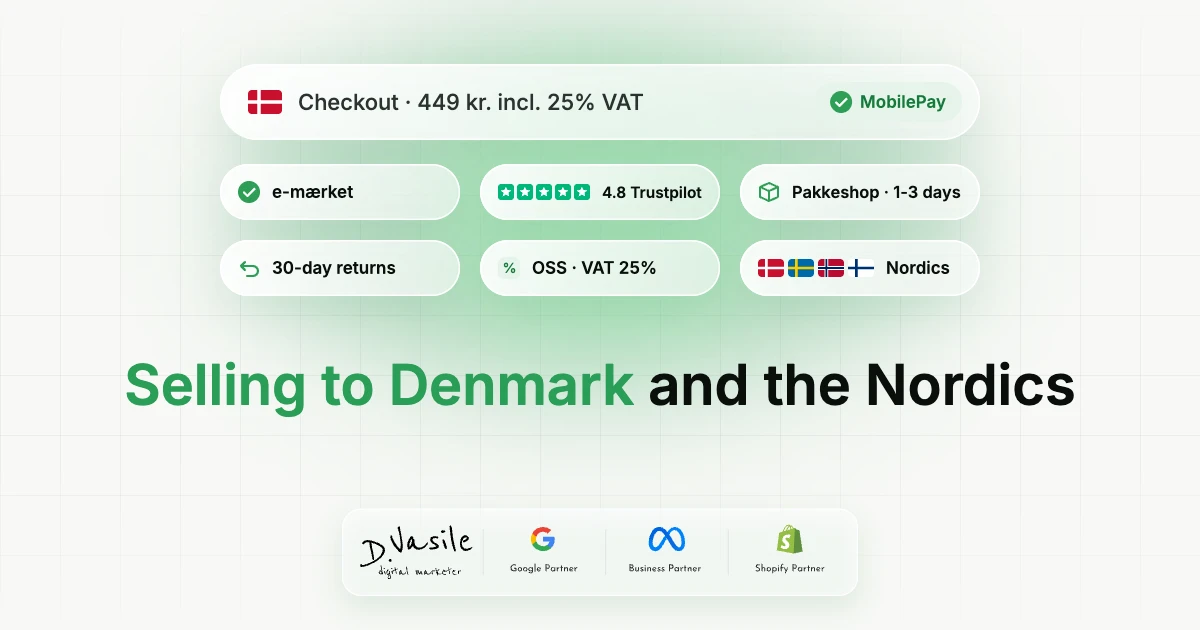
On paper, Denmark looks like the ideal market for a webshop from elsewhere in the EU: customers with high purchasing power, almost everyone shops online, and shipping from another EU country means no customs. Yet many foreign webshops that try to sell there give up after a few months. Not because of price or product, but because a Danish customer doesn't buy from a shop they don't trust, and trust is built differently here than in many other countries.
In this guide I show you what you need in place before running your first ad in Denmark: the trust signals that matter to Danes, payment methods, delivery, returns, VAT and how to work out whether anything is left from each order. I also cover Sweden, Norway and Finland, because once Denmark works, the next step is usually one of them. Halfway through there is an interactive margin calculator.
Why Denmark is worth it
- Bigger baskets. A product that sells for 30 € in Southern or Eastern Europe can often sell for 300-400 kr., or 40-55 €, in Denmark without seeming expensive.
- Customers used to shopping online and paying by card or MobilePay, not cash on delivery.
- No customs, since it's an EU market, and a stable currency: the Danish krone is pegged to the euro at about 7.46 DKK per €1.
- A small but wealthy market. With around 6 million people, you can test with reasonable budgets.
The harder part: local competition is good, customers have high expectations for delivery and returns, and an unknown shop from abroad has a hard time earning trust.
Trust: what a Danish customer checks before buying
Danes have very high trust in each other and in institutions, but they are careful with webshops they don't know. Before a first order, a customer usually checks a few things.
e-mærket
e-mærket is the best-known trustmark in Denmark, run by Dansk Erhverv. A certified shop commits to following Danish consumer law, and the customer has a route for resolving disputes. According to Dansk Erhverv, nearly three in four consumers feel safer buying from a shop with e-mærket. Certification has an annual fee and includes a review of your site and terms. Check the conditions for shops based outside Denmark before relying on it.
Trustpilot and Google reviews
Trustpilot is a Danish company and was long the first stop for a customer wanting to check a shop. But behaviour is changing. A Dansk Industri study of Christmas shopping in 2025 found that 8 in 10 Danes look for recommendations before buying, that Trustpilot use fell markedly, and that Google gained 8 percentage points as a source of recommendations. The practical conclusion: you need reviews on both Trustpilot and Google, and an empty profile or one with few reviews is a negative signal.
Company number, address and contact details
Danes are used to seeing the CVR number, the company registration number, in the footer of every webshop. As a foreign shop you will have your own national registration and EU VAT number. Show them clearly, along with your full address, a contact email and, if possible, a phone number. A shop that hides its company details loses from the start.
Language
Most Danes speak excellent English, but that doesn't mean they will buy from an English-language shop. For consumer products, a site in Danish converts noticeably better. Machine translation is recognised immediately and lowers trust. Pay a native translator at least for your main product pages, checkout, terms and automated emails.
Payments: what you need at checkout
Payment methods Importance MobilePay Essential. The most used mobile payment in Denmark Visa/Dankort Essential. The national card, usually co-branded with Visa Visa and Mastercard Essential Apple Pay and Google Pay Recommended, especially on mobile Klarna (pay later) Useful for larger baskets Cash on delivery Practically non-existent, don't offer itMissing MobilePay is one of the most common reasons a Danish customer abandons the cart at a foreign shop. Payment providers like Stripe, Adyen or Quickpay, and platforms like Shopify, let you add it. Check whether your provider supports it for companies based outside Denmark.
Delivery and returns
Danes are used to fast delivery, usually in 1-3 working days, and prefer delivery to a pakkeshop (a parcel pickup point in a shop) or a locker rather than to the door. The main carriers are PostNord, GLS, DAO and Bring.
From most of Central or Eastern Europe, a realistic delivery to Denmark takes 3-5 working days via GLS, DPD or a shipping integrator. That's acceptable on one condition: you say so clearly on the product page and in checkout, with an estimated date. A customer who knows the parcel arrives on Thursday isn't bothered. One who knows nothing sends an email after three days. I wrote about this in the article on the estimated delivery date on the product page.
A few practical rules:
- Offer delivery to a pakkeshop via GLS or PostNord, with the pickup point chosen directly in checkout.
- Show the shipping cost in kroner before checkout, not just at the end. A free shipping threshold around 400-500 kr. is common.
- Returns must be simple. The legal EU right of withdrawal is 14 days, but many Danish shops offer 30. Provide a prepaid return label or a return point in Denmark rather than asking the customer to ship the parcel abroad themselves.
- Include return costs in your margin. A return from Denmark to another EU country can cost almost as much as the original shipping. I explain how to reduce them in the article on the cost of ecommerce returns.
Prices and VAT
Prices for Danish customers should be shown in Danish kroner, including VAT. The standard VAT rate in Denmark is 25%.
For an EU webshop selling to consumers in other EU countries, the basic rule is the €10,000 annual threshold, calculated across all distance sales to consumers in other EU countries combined. Below it, you can charge your home country's VAT. Above it, you charge the customer's country's VAT, 25% in Denmark, and report it through the OSS (One Stop Shop) scheme in your home country, without registering separately in each country. Talk to your accountant before your first sale, because the threshold is reached quickly.
One easily missed detail: if you advertise a discount, the reference price must be the lowest price you charged in the last 30 days. The rule comes from the EU Omnibus directive and applies across the EU, but the Danish Consumer Ombudsman is known for strict enforcement.
Calculate your margin per order
Before you start advertising in Denmark, run this calculation with your own numbers. The calculator accounts for the country's VAT, your return rate (it assumes you pay shipping both ways on returns and that 10% of returned products can't be resold), payment fees and ad cost.
A concrete example: a ceramics studio sells a handmade mug for 60 € in Denmark, VAT included. The product costs 18 €, shipping 9 €, the payment fee is 2.5%, the return rate 8%, and ads cost an average of 12 € per order. Excluding VAT, revenue is 48 €. After product, shipping, returns, fees and ads, only about 4.2 € is left per order, under 9% of revenue, and the break-even ROAS is almost 3. A single 10% discount turns the order into a loss. Raising the price to 69 €, still reasonable for a handmade mug in Denmark, lifts the margin to about 10.6 €, or 19% of revenue. Change the values in the calculator to see the difference yourself.
If your result is negative, you have three options: a higher price (often possible in Denmark), bigger baskets through bundles or a free shipping threshold, or lower shipping costs negotiated with an integrator. I explain the logic behind this calculation in the article on contribution margin vs ROAS.
Trust checklist for a foreign webshop in Denmark
Header and footer What you need Company details Name, registration and VAT number, full address, email, phone Trust signals e-mærket if you have it, and your Trustpilot or Google score Language Full site in Danish, prices in kr. Product page What you need Delivery Estimated delivery date and cost in kr. Returns Number of days and how it works, in one sentence Reviews Reviews with text, ideally from customers in Denmark Checkout What you need Payments MobilePay, Visa/Dankort, Apple Pay Delivery Choose a pakkeshop directly in checkout Costs No new costs appearing at the last step After the order What you need Emails Confirmation and tracking in Danish Support Reply within 24 hours, in Danish or EnglishAdvertising in Denmark: where to start
A new webshop in Denmark has no reviews, no branded searches and no returning customers. That's why the first months are about trust, not just ROAS.
- Google Shopping and Performance Max are usually the best starting point, because they reach customers already searching for the product. You need a separate Danish feed with prices in DKK. Details in the guide to Performance Max for webshops.
- Meta works well for visual products and for building awareness, with ads in Danish and ideally reviews from your first Danish customers.
- Your first 50-100 customers matter enormously. Ask every one of them for a review and reply to all of them, including the negative ones.
Sweden, Norway and Finland: what's different
Sweden What you need to know VAT 25% Currency Swedish krona (SEK) Payments Swish, Klarna, cards Trust Trygg e-handel, the trustmark from Svensk Handel Language Swedish. Don't use Danish for Swedish customers Norway What you need to know VAT 25% Currency Norwegian krone (NOK) Payments Vipps, Klarna, cards Special case Not in the EU. For goods under NOK 3,000 you register in the VOEC scheme and collect Norwegian VAT at checkout once you pass NOK 50,000 in annual sales. Items over NOK 3,000 go through regular import with customs Finland What you need to know VAT 25.5% Currency Euro Payments Online bank payments, MobilePay, Klarna, cards Language Finnish, with Swedish as the second official languageSweden and Finland work like Denmark from a tax point of view: they fall under the same €10,000 threshold and the same OSS scheme. Norway is more complicated because it isn't in the EU, so it's worth tackling after you have experience in the other three.
A 6-step launch plan for Denmark
- Calculate your margin on your first 10 products, using the prices you would charge in Denmark.
- Get a professional translation of your main pages, checkout, terms and emails.
- Add MobilePay and pakkeshop delivery to checkout.
- Clarify VAT and OSS with your accountant.
- Create your profiles on Trustpilot and Google and start automated review requests.
- Start with Google Shopping on a small budget, then add Meta after your first reviews.
Frequently asked questions
Conclusion
Denmark can be a very good market for a webshop from abroad, but it isn't one you enter just by translating your site and running a Facebook campaign. You earn trust with clear company details, MobilePay, predictable delivery, simple returns, real reviews and a site in proper Danish. Calculate your margin before you start advertising, and expand into Sweden or Finland once Denmark works. I live in Denmark and work with webshops in several markets, so if you'd like to plan your entry together, you'll find details on the ecommerce strategy page, or you can write to me on the contact page.