Pre-orders behind the scenes: stock, cash flow and what nobody tells you after the first 100 orders
Stock prioritisation, mixed orders, the operator's workload, pre-orders with no deposit and the legal delivery deadline, from 4 years of pre-orders at ALURA. With a stock vs pre-order calculator.
Vasile Dingă
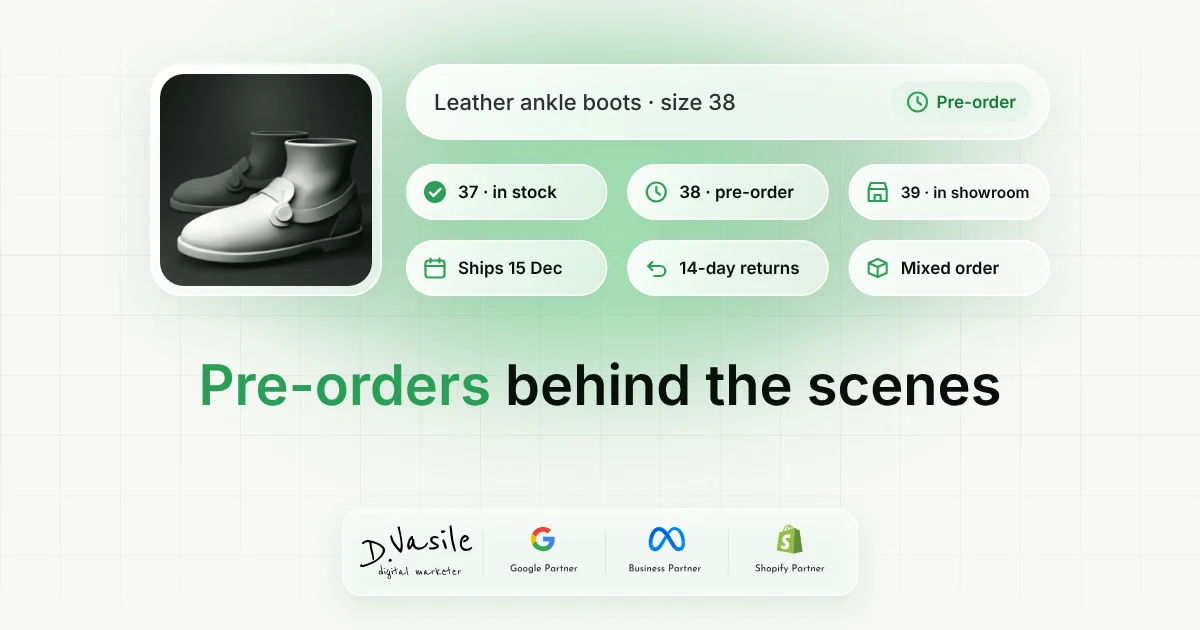
Most writing about pre-orders covers the nice part: you get paid before you produce, you test a collection without risk, and you stop getting stuck with unsold stock. I wrote about that too in Launch successful collections without risk with pre-orders . What gets written about less is what happens after the first hundred orders: baskets with in-stock and pre-order items together, sizes that sit on the showroom shelf but not in the warehouse, a team member losing an hour a day ticking settings, and customers asking support when their parcel will arrive. For 4 years I built and optimised the pre-order system for ALURA, a Romanian footwear brand with a webshop and a showroom in Bucharest. In this article I show you the part behind the scenes: how to decide what sells from stock and what sells as a pre-order, how to handle mixed orders, how to get rid of manual work and how to work out what stock produced upfront really costs you. Halfway through there is a calculator to compare both options with your own numbers. A pre-order is not a button, it's a stock rule Most shops start pre-orders like a label: put "Pre-order" on the product, write a delivery date in the description, done. That works for one new product. It stops working when the same model has sizes in stock, sizes in production and sizes that don't exist yet. The right question is not "is this product on pre-order?" but "for this variant , right now, where does the unit the customer buys come from?". The answer can be: the warehouse, the showroom, the next production batch, or nowhere. Each answer means a different message on the product page, a different delivery date and a different route through logistics. Stock prioritisation: what's on the shelf goes first The rule I implemented at ALURA is simple: the system automatically sells the units that physically exist first, and only then switches the variant to pre-order. The customer doesn't choose between "in stock" and "pre-order". They simply see the fastest…