How I see the future of e-commerce in Romania
In 2025, Romania's e-commerce market keeps growing and has passed 11% of total retail, driven by changing consumer behavior and the rapid digitalization of businesses.
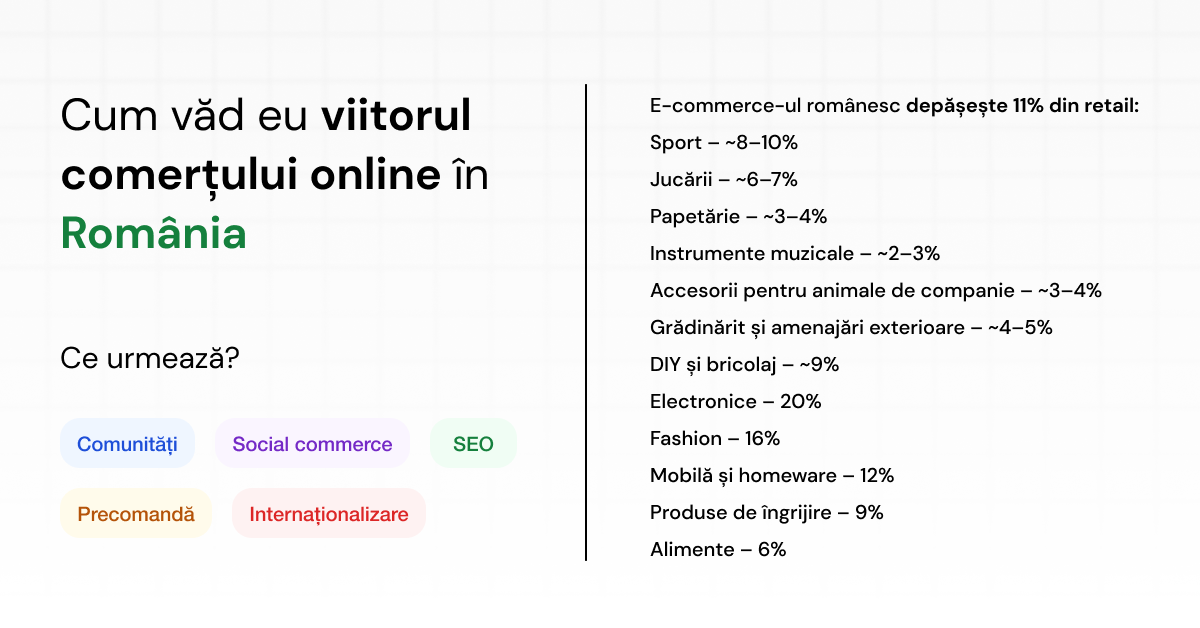
In 2025, Romania's e-commerce market keeps growing and has passed 11% of total retail, a clear sign that online shopping is becoming an ever bigger part of everyday life. At the same time, the economy is going through a challenging period: high inflation, modest growth and rising marketing costs.
For me, as a digital marketer with access to and experience in several verticals, including fashion, automotive and services, 2025 is no longer about fast, aggressive sales, but about building solid, sustainable relationships adapted to the reality of the market. In this article I'll tell you what I recommend to brands so they can hold their ground and grow in the long run.
Less PPC, more community
In 2025, paid advertising is still important, but real, sustainable success in e-commerce comes from building a strong community around the brand. For that, I use an ecosystem of three complementary channels: WhatsApp marketing, email marketing and private groups.
WhatsApp marketing
WhatsApp is the preferred channel for millions of people for fast, personal communication. Recently launched white-label tools integrate directly with e-commerce platforms via API, offering:
-
Flexible, personalized automations for sending tailored messages (e.g. reminders for products left in the cart, low-stock notifications, exclusive offers);
-
Real-time conversations with customers, for support and personalized recommendations, through human operators, automations or an AI virtual assistant connected to the product feed;
-
Segmented, scalable campaigns, without the limits imposed by other social platforms.
This approach pushes open and conversion rates well above the average of other channels, and customers feel they're treated as people, not just numbers.
Email marketing
Email remains an essential part of the community ecosystem:
-
Send newsletters with relevant, educational content that adds value and builds trust;
-
Offer exclusive access to launches, promotions or events, encouraging a sense of belonging;
-
Segment your lists to personalize messages and make your communication more relevant.
This way, email marketing strengthens the bond between the brand and its community and encourages repeat purchases.
Private groups and Instagram communities
Private groups on WhatsApp or Facebook become the center of the community, where members can:
-
Interact freely and share experiences and feedback;
-
Take part in exclusive discussions and events;
-
Feel part of something unique and valuable.
This involvement means the brand is seen not just as a seller, but as a trusted partner and a source of inspiration.
The complete community ecosystem
Together, these three channels form a complete ecosystem in which each part supports and amplifies the others:
-
WhatsApp brings speed and personalization;
-
Email provides in-depth content and loyalty;
-
Private groups create belonging and real interaction.
This ecosystem reduces dependence on large advertising budgets, increases customer retention and turns occasional shoppers into genuine brand ambassadors.
SEO, AIO, AEO and GEO
As technology evolves, website optimization becomes more complex, and classic SEO strategies need to be complemented by new practices that take artificial intelligence and new kinds of search engines into account.
1. SEO (Search Engine Optimization)
SEO remains the essential starting point for any online business. For e-commerce, the focus is on:
-
Creating a clear structure with indexable categories and specific filters (e.g. "shoes size 37", "black women's shoes") that bring relevant traffic with purchase intent.
-
Technical optimization: loading speed, intuitive navigation and a friendly user experience.
-
Implementing structured data (schema.org) for products, reviews and offers, so search engines understand the content better.
-
Preventing duplicate content and using canonicals correctly.
Classic SEO ensures visibility in traditional search engine results.
2. AI Optimization (AIO): optimizing for artificial intelligence
AIO means adapting your site and content so they can be understood and processed efficiently by the AI algorithms built into modern search engines.
Best practices:
-
Organizing content semantically, with clear relationships between entities and pages.
-
Implementing advanced markup (schema.org) to provide detailed context.
-
Managing special files, such as llm.txt, which guide AI in prioritizing content.
-
Optimizing user experience and speed to support good scores in AI algorithms.
3. Answer Engine Optimization (AEO): optimizing for answer engines
AEO focuses on optimizing content for voice and conversational searches, where search engines give direct, concise and useful answers.
Best practices:
-
Creating structured content for frequently asked questions (FAQ), HowTo sections and Q&A, all marked up with schema.org.
-
Optimizing for natural language, focusing on the questions people ask out loud.
-
Winning prime positions in the SERP (featured snippets) that give users quick answers.
4. Generative Engine Optimization (GEO): optimizing for generative AI
GEO aims to optimize websites so that generative AI models (e.g. LLMs) can extract information and generate detailed, personalized and relevant answers for users.
Best practices:
-
Building a clear, coherent site architecture, with well-defined hierarchies and links between pages.
-
Implementing detailed semantic markup (schema.org) to provide full context.
-
Using special files such as llm.txt to guide AI models in understanding your content and priorities.
Creating semantically rich content that enables complex answers, not just simple keyword extraction.
In 2025, an effective SEO strategy has to integrate all of these dimensions:
-
Classic SEO for fundamental visibility;
-
AIO for compatibility with AI algorithms;
-
AEO for presence in conversational and voice search;
-
GEO to support generative AI models;
By applying these practices together, you'll have a site ready for the future of digital search, with a strong and sustainable presence in the AI ecosystem.
Social commerce: a focus on live shopping, the new frontier of online sales in Romania
In Romania, social commerce is evolving fast, and in 2025 live shopping is becoming one of the most dynamic sales channels. Unlike other forms of social commerce, live shopping offers an interactive, engaging and authentic experience, where shoppers can see products in action, ask questions in real time and make instant buying decisions.
Why live shopping?
-
Real-time interaction: unlike classic ads or static posts, live shopping creates a direct connection between brand and consumer, building trust and a sense of community.
-
Fast conversions, as the audience is motivated to buy on the spot, taking advantage of exclusive offers or limited stock announced live.
-
Authentic, entertaining content, where presenters can demonstrate product benefits, answer questions immediately and create an event atmosphere that drives sales.
Live shopping in Romania in 2025
Even though it's still a growing channel, live shopping is capturing the attention of more and more Romanian shoppers:
-
In 2024, over 30% of active social media users in Romania watched at least one live shopping event.
-
Platforms such as Facebook and TikTok have started rolling out local features for merchants, offering streaming tools and simplified payment integration.
-
Live commerce is most popular in fashion, beauty and electronics, where the visual presentation of products matters a lot.
How can you take advantage of live shopping?
-
Plan regular sessions with clear themes, product launches or special offers.
-
Use authentic presenters who communicate naturally and build an emotional connection with the audience.
-
Add real-time feedback mechanisms to answer questions and adjust the presentation.
-
Promote events in advance to grow the audience and build anticipation.
Live shopping is more than a trend: it's a fundamental shift in how Romanians interact with brands online. Adopting this channel can make the difference between a brand that just sells and one that builds an engaged, loyal community.
Pre-orders: a sustainable, efficient business model
In today's online retail landscape, where shoppers are increasingly demanding and resources have to be managed responsibly, the pre-order model is establishing itself as a smart solution for brands that want to grow sustainably and reduce financial risk.
What is a pre-order?
A pre-order is a way for customers to order a product before it's actually in stock or in production. The system works as a mutual commitment: the brand secures demand and the funds needed for production, and the customer gets a guarantee that they'll receive the product in the near future.
The business advantages of pre-orders
-
Lower financial risk and less excess stock
With pre-orders, brands avoid large investments in stock that may go unsold. Production and supply follow real demand, eliminating waste and the costs of unused or depreciated stock.
-
Better cash flow and demand-based financing
Pre-orders bring in funding before production, helping manage cash flow and plan financial resources more efficiently. This is especially important for small or growing brands.
-
Market validation and real-time feedback
The model lets you test interest in a product before the official launch. Brands can then adapt the design, quantity or strategy based on customer feedback, improving their chances of success.
-
More exclusivity and customer loyalty
Products available through pre-order can feel exclusive or limited, which builds a sense of belonging and anticipation among customers. This experience increases retention and referrals.
Pre-orders: a competitive advantage in 2025
In an increasingly competitive and volatile market, where sustainability is becoming a more important criterion for shoppers, the pre-order model offers:
-
Flexibility in managing resources;
-
A lower environmental impact by eliminating surplus;
-
Fast adaptation to changing trends;
-
An authentic relationship with the customer.
A practical example
I designed, implemented and optimized a complex pre-order system for a premium fashion brand, integrating it directly into the ordering process, with clear payment options and individually personalized delivery dates. All built into the standard checkout process.
The result? A higher conversion rate, a significant reduction in stock costs and, gradually, a growing product retention rate.
The pre-order model isn't just a sales tactic, but a sustainable, efficient strategy that helps brands grow healthily, manage resources better and offer customers a superior experience.
Automation and funnel optimization: done by the book
For automations to be effective and not annoy customers, the whole process has to be carefully analyzed, planned and personalized.
Analyzing conversion times and sending at the right moment
An essential step is identifying the hours and days when customers and prospects are most receptive:
-
Use historical campaign and analytics data to find the hours when users convert or engage the most.
-
Avoid sending emails or messages when most people are asleep (e.g. late at night or very early in the morning), to avoid frustration and increase open rates.
-
Adjust your automations so each segment receives communication at the right time for them.
Controlling frequency and avoiding over-sending
Nobody wants to receive so many emails or messages that they become annoying:
-
Set clear limits on how often automated messages go out (e.g. max 1-2 emails a week during a lead nurturing stage).
-
Monitor customer reactions (unsubscribes, spam reports) to fine-tune the volume and content of your messages.
-
Include clear options to unsubscribe or set communication frequency preferences.
Correct exclusions and segmentation: avoiding funnel overlap
To offer a coherent, personalized experience, a customer or prospect shouldn't be targeted by several funnels at once:
-
Use clear exclusion criteria so someone who is already buying doesn't receive lead nurturing messages.
-
Avoid sending pre-order offers to people who already have pending orders or products in their cart.
Segment and sync your lists to prevent overlap. -
Use tags and labels in your CRM to track each contact's stage and manage flows automatically.
Continuous analysis and optimization
Automations and funnels need constant monitoring:
-
Analyze conversion, open, click and unsubscribe rates.
-
Adjust messages and send intervals to optimize performance.
-
Run A/B tests to see what works better.
Diversifying channels and the steps toward going international
Now that online retail in Romania has passed 11% of total retail and competition is getting fiercer, local brands need to think strategically about diversifying their sales channels and expanding into foreign markets to grow sustainably and strengthen their position.
Why is channel diversification essential?
Each digital channel gives you access to a different audience and creates unique sales opportunities:
-
Online and offline stores: the foundation for full control over the brand and the customer experience.
-
Local and international marketplaces (eMAG, Zalando, Fashion Days): fast access to a large audience already used to shopping online.
-
Social commerce: selling directly through social platforms (Instagram Live, TikTok Live), where users spend a lot of time and can buy instantly.
-
Alternative channels: WhatsApp, email marketing, SMS, live shopping and custom mobile apps.
Diversification reduces dependence on a single channel and makes the business more resilient to changes in algorithms, trends or regulations.
Essential steps for taking a Romanian brand international
1. Analyzing the target market and adapting the offer
-
Identify the countries with real potential for your products, taking into account demand, competition and consumer behavior.
-
Study cultural aspects, local preferences and specific legislation (e.g. VAT rules, returns, certifications).
-
Adapt the product and communication to the local market (language, messages, prices, payment options).
2. Choosing the right distribution channels
-
Start with well-known marketplaces in the target country (Amazon Europe, Zalando, Allegro and so on) to test interest.
-
Expand to local social networks and explore the social commerce options mentioned above.
-
Develop a localized website or a dedicated section on your site in the local language and currency.
3. Logistics and customer support
-
Ensure efficient logistics and competitive costs for international shipping.
-
Offer support in the local language and flexible return options to win customers' trust.
4. Localized digital marketing
-
Run PPC, SEO and social media campaigns adapted to the market, using local data and insights.
-
Build communities and authentic relationships with customers in that country.
5. Continuous monitoring and optimization
-
Constantly analyze performance by channel and by country.
-
Adjust the strategy based on feedback, trends and results.
Challenges specific to the Romanian market
-
Consumer mindset: Romanian shoppers are increasingly open to buying online, but they pay close attention to value for money and to trust in new brands.
-
Logistics and costs: infrastructure and delivery costs can significantly influence purchase decisions.
-
Tax regulations: Romanian and European legislation require constant adaptation, especially around VAT and consumer protection.
In 2025, success in e-commerce on the Romanian market requires a complex, well-integrated approach. Classic SEO, combined with new practices for artificial intelligence (AIO, AEO, GEO), ensures relevant and sustainable visibility. Well-targeted PPC campaigns bring qualified traffic and support every stage of the funnel, which must be carefully optimized and automated to avoid overwhelming customers.
Building a strong community through channels such as WhatsApp marketing, email and private groups creates an authentic, loyal ecosystem that is essential for retention and scaling. Diversifying sales channels (your own site, local and international marketplaces, social commerce) increases access to new customers and reduces risk.
The pre-order model helps manage resources efficiently and finance production based on real demand, while going international is the natural next step for expanding the business and increasing profitability.
In a dynamic, competitive digital landscape, success belongs to those who smartly integrate all of these elements, building a business that is sustainable, scalable and ready for the future.