E-invoicing for B2C sales in Romania: what foreign and Romanian online stores must know
Since 2025, invoices to private customers in Romania go through e-Factura, and since 2026 the deadline is 5 working days. CNP and the 13 zeros, cash on delivery, credit notes, fines and automation.
Vasile Dingă
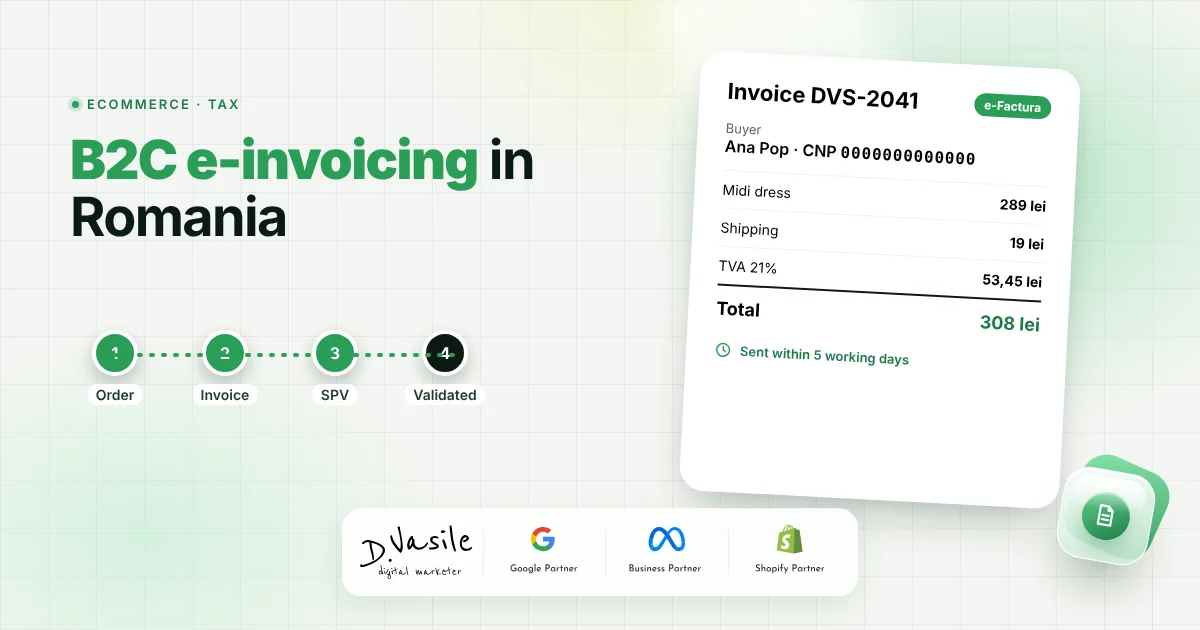
Since 1 January 2025, businesses established in Romania must send invoices issued to private individuals through the RO e-Factura system, not only invoices to other companies. For a Romanian online store, that means almost every delivered order produces an invoice that has to reach ANAF, the Romanian tax authority. The rules have changed since then, including in 2026, so below is the current version explained in online store terms: what foreign and Romanian stores need to know and how to automate it so you never upload anything by hand. This is not a complete tax guide: for your own business, always check with your accountant. What changed and when 1 July 2024: e-Factura becomes mandatory for invoices between businesses (B2B). 1 January 2025: it also becomes mandatory for invoices to private individuals (B2C), for supplies of goods and services taxable in Romania, issued by taxable persons established in Romania. 1 July 2025: fines start to apply for B2C invoices that are not transmitted. The first six months of 2025 were in practice a transition period. 1 January 2026: the transmission deadline becomes 5 working days from the invoice date, for both B2B and B2C. Before, the rule referred to 5 calendar days. 2026: Law no. 88/2026, approving Emergency Ordinance 128/2024, brings clarifications: for example, suppliers identified for tax purposes by a personal ID number (CNP) are no longer required to transmit invoices, but can use the system voluntarily after registering in the optional register. Foreign stores selling to Romania The B2C obligation is aimed at taxable persons established in Romania selling domestically. A Danish or other EU store shipping to Romanian consumers and declaring VAT through the EU One Stop Shop (OSS) is generally outside the B2C e-Factura obligation. Things change if you have an establishment in Romania, are registered for VAT there, sell from a Romanian warehouse or invoice Romanian companies. The rules on non-established businesses have…